
Last Updated on June 20, 2026 by I Love Spanish Club
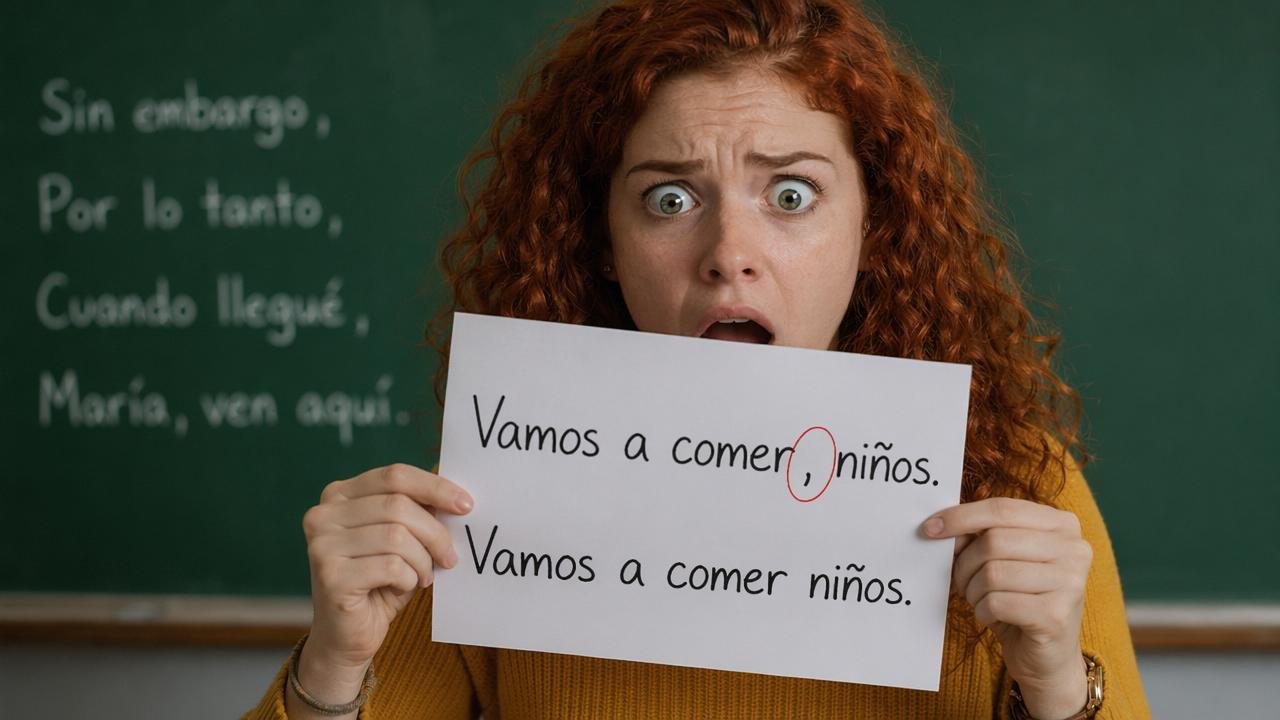
The comma (la coma) in Spanish works similarly to English in many ways — but there are important differences that trip up English speakers, especially regarding lists, conjunctions, and subordinate clauses. Getting comma rules right makes your written Spanish look polished and professional. This guide covers every comma rule you need for clear, correct Spanish writing. ¡Empecemos! (Let’s begin!)
📋 Overview — When to Use a Comma in Spanish
| Use | Example |
|---|---|
| Separating items in a list | Compré pan, leche, huevos y fruta. |
| After introductory expressions | Sin embargo, no pude ir. |
| Setting off appositives | Mi hermana, la doctora, llegó tarde. |
| Before/after direct address | María, ven aquí. |
| Separating subordinate clauses | Cuando llegué, ya habían comido. |
| After transitional phrases | Por lo tanto, decidimos salir. |
| Decimal numbers (in Spanish) | El precio es 3,50 euros. |
📝 Rule 1 — Lists (Enumeraciones)
Use commas to separate items in a list. In Spanish, you do not use a comma before the final “y” (and) or “o” (or) — this is different from English, which often uses the Oxford comma.
| Spanish | English |
|---|---|
| Compré pan, leche, huevos y fruta. | I bought bread, milk, eggs and fruit. |
| Habla inglés, español, francés e italiano. | She speaks English, Spanish, French and Italian. |
| ¿Prefieres café, té o jugo? | Do you prefer coffee, tea or juice? |
📝 Rule 2 — Introductory and Transitional Expressions
When a sentence begins with a transitional expression or connective, place a comma after it:
| Expression | Meaning | Example |
|---|---|---|
| Sin embargo, | However, | Sin embargo, no pudimos ir. |
| Por lo tanto, | Therefore, | Por lo tanto, decidimos quedarnos. |
| Además, | Furthermore / Also, | Además, tenemos que estudiar. |
| Por ejemplo, | For example, | Por ejemplo, puedes usar el metro. |
| Es decir, | That is to say, | Es decir, no hay solución. |
| En cambio, | On the other hand, | En cambio, ella sí llegó. |
| Por cierto, | By the way, | Por cierto, mañana hay reunión. |
📝 Rule 3 — Direct Address (Vocativo)
When you address someone directly by name or title, set it off with a comma. This is essential — leaving out the comma can actually change the meaning:
María, ven aquí. — María, come here. (you’re calling María)
María ven aquí. — without comma, less clear who is speaking to whom
Vamos a comer, niños. — Let’s eat, children.
Vamos a comer niños. — Let’s eat children. ⚠️ (famous example of why commas matter!)
| Spanish | English |
|---|---|
| Gracias, profesor. | Thank you, teacher. |
| Por favor, señora García, pase. | Please, Mrs. García, come in. |
| Oye, Carlos, ¿me puedes ayudar? | Hey Carlos, can you help me? |
📝 Rule 4 — Subordinate Clauses Before the Main Clause
When a subordinate clause comes before the main clause, use a comma to separate them:
| Spanish | English |
|---|---|
| Cuando llegué, ya habían comido. | When I arrived, they had already eaten. |
| Si tienes tiempo, llámame. | If you have time, call me. |
| Aunque estaba cansada, terminó el trabajo. | Although she was tired, she finished the work. |
| Como no había taxi, fuimos a pie. | Since there was no taxi, we went on foot. |
📝 Rule 5 — Appositives and Parenthetical Information
When you add extra information about a noun (an appositive), enclose it with commas:
| Spanish | English |
|---|---|
| Mi hermana, la doctora, llegó tarde. | My sister, the doctor, arrived late. |
| Bogotá, la capital de Colombia, es enorme. | Bogotá, the capital of Colombia, is enormous. |
| El español, un idioma hermoso, se habla en 20 países. | Spanish, a beautiful language, is spoken in 20 countries. |
📝 Rule 6 — Decimals and Numbers
This is a major difference from English. In Spanish, a comma is used as the decimal separator, while a period is used as the thousands separator:
| English | Spanish |
|---|---|
| 3.50 (three and a half) | 3,50 |
| 1,000 (one thousand) | 1.000 |
| 1,500.75 | 1.500,75 |
| 0.5% | 0,5% |
💬 Real Conversation: Commas in Context
📍 Teacher correcting a student’s writing
Profe: Mira, Pablo, aquí falta una coma. Escribiste: “Vamos a comer niños” — ¡eso significa que vamos a comernos a los niños!
Look, Pablo, there’s a comma missing here. You wrote: “Let’s eat children” — that means we’re going to eat the children!
Pablo: ¡Ay, no! ¿Entonces cómo se escribe?
Oh no! So how do you write it?
Profe: “Vamos a comer, niños.” Con coma antes del vocativo. Además, en esta oración también te falta la coma después de “sin embargo”.
“Let’s eat, children.” With a comma before the direct address. Also, in this sentence you’re also missing the comma after “sin embargo”.
Pablo: Entendido. Por lo tanto, las comas son muy importantes.
Understood. Therefore, commas are very important.
Profe: ¡Exacto! Y bien usada la coma después de “por lo tanto”.
Exactly! And well used the comma after “por lo tanto”.
⚠️ Common Mistakes
❌ Using Oxford comma in Spanish
✅ pan, leche y huevos — no comma before “y” in standard Spanish lists.
❌ Missing comma after transitional expressions
✅ Sin embargo, / Por lo tanto, / Además, — always followed by comma.
❌ Missing comma in direct address
✅ Gracias, María — not “Gracias María”. The comma before/after a name in direct address is essential.
❌ Using period for decimals
✅ In Spanish: 3,50 not “3.50” — comma for decimals, period for thousands.
❌ Putting comma before subordinate clause that follows main clause
✅ Llámame si tienes tiempo — no comma needed when the “if/when” clause comes after.
🎯 Quiz: Add the Missing Commas
Add commas where needed:
- Compré café azúcar leche y pan.
- Sin embargo no pudimos terminar.
- Carlos ayúdame por favor.
- Cuando llegaron ya era tarde.
- Mi perro un labrador dorado es muy amigable.
- El precio es 2.50 euros. (convert to Spanish format)
👁️ Show Answers
- Compré café, azúcar, leche y pan. — list, no comma before y
- Sin embargo, no pudimos terminar. — after transitional expression
- Carlos, ayúdame por favor. — direct address
- Cuando llegaron, ya era tarde. — subordinate clause before main
- Mi perro, un labrador dorado, es muy amigable. — appositive
- El precio es 2,50 euros. — comma for decimals in Spanish
❓ Frequently Asked Questions
Does Spanish use the Oxford comma?
No. Standard Spanish does not use the Oxford comma (the comma before “y” or “o” in a list). The Real Academia Española explicitly advises against it in most cases. So while English might write “coffee, tea, and juice”, Spanish writes café, té y jugo — no comma before “y”.
Why is the comma used for decimals in Spanish?
This is a European convention that Spanish inherited. Most of Europe uses a comma as the decimal separator and a period (or space) as the thousands separator — the opposite of the US system. This applies throughout Spain and Latin America, though some countries are gradually adopting the international standard. Always use the comma for decimals when writing in Spanish.
What’s the best way to improve my Spanish punctuation?
Read quality Spanish content regularly — news articles, books, well-written blogs. Pay attention to how commas are used in sentences with sin embargo, cuando, aunque and in lists. Working with a native tutor on Italki on writing exercises is also very effective — they can spot punctuation errors that spell-checkers miss.