
Last Updated on June 20, 2026 by I Love Spanish Club
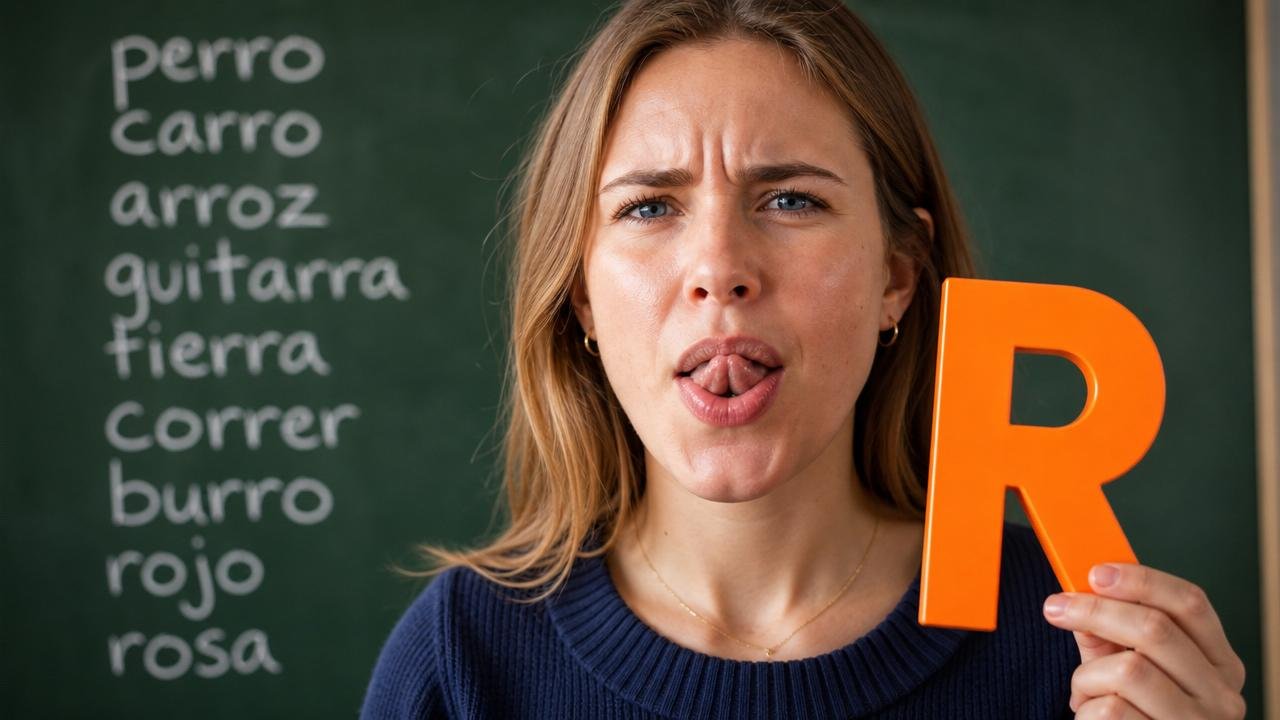
One of the most iconic challenges of learning Spanish pronunciation is the letter R — and its double version RR. The rolled or trilled R is one of the sounds that most English speakers struggle with, and getting it right makes a huge difference in how natural your Spanish sounds. But beyond pronunciation, there are also clear rules about when to write R vs RR. This guide covers everything — sounds, spelling rules, minimal pairs, and practice tips. ¡Rrrrrepasemos! (Let’s review!)
🔊 Two Different R Sounds in Spanish
Spanish has two distinct R sounds — a soft R and a strong/trilled R. These are not interchangeable — using the wrong one can actually change the meaning of a word.
Soft R (single R between vowels) — a quick single tap of the tongue against the roof of the mouth, similar to the “tt” sound in American English “butter” or “water”.
pero, caro, cara, pera
Strong/Trilled R (RR or R at start of word) — a vibrating trill where the tongue rapidly taps the roof of the mouth multiple times.
perro, carro, rojo, rosa
📊 When to Use Each R Sound
| Position | Sound | Examples |
|---|---|---|
| R at the beginning of a word | Strong/trilled R | rojo, rosa, río, rey |
| R between vowels (single R) | Soft R | pero, caro, pera, arena |
| R after N, L, S | Strong/trilled R | Enrique, alrededor, Israel |
| R at the end of a syllable | Soft R | comer, hablar, amor |
| RR (always between vowels) | Strong/trilled R | perro, carro, arroz, guitarra |
⚠️ Minimal Pairs — Words That Change Meaning
This is why the R vs RR distinction matters so much — these word pairs sound different and mean completely different things:
| With soft R | Meaning | With strong RR | Meaning |
|---|---|---|---|
| pero | but | perro | dog |
| caro | expensive | carro | car / cart |
| pera | pear (fruit) | perra | female dog |
| cero | zero | cerro | hill |
| para | for / to | parra | grapevine |
| ahora | now | ahorra | he/she saves (money) |
📝 Spelling Rules: When to Write RR
RR is only written in one specific situation: between two vowels, when the strong trilled sound is needed.
| Spanish | English | Rule |
|---|---|---|
| perro | dog | strong R between vowels = RR |
| arroz | rice | strong R between vowels = RR |
| guitarra | guitar | strong R between vowels = RR |
| burro | donkey | strong R between vowels = RR |
| tierra | earth / land | strong R between vowels = RR |
| correr | to run | strong R between vowels = RR |
in + racional = irracional (irrational)
sub + rayar = subrayar — wait, no doubling here because L precedes R, which already gives strong R
pre + requisito = prerrequisito (prerequisite)
💬 Real Conversation: R and RR in Action
📍 At a restaurant
Cliente: Por favor, ¿me puede traer arroz con pollo? Pero sin cebolla.
Please, can you bring me rice with chicken? But without onion.
Mesero: Por supuesto. ¿Y de beber?
Of course. And to drink?
Cliente: Un agua, por favor. Oiga, ¿tienen perros permitidos aquí? Tengo mi perro afuera.
A water, please. Excuse me, are dogs allowed here? I have my dog outside.
Mesero: Sí, en la terraza pueden entrar. El restaurante es muy tranquilo.
Yes, on the terrace they can come in. The restaurant is very quiet.
🗣️ How to Practice the Trilled R
Step 1: Say “butter” or “water” in American English quickly — that middle “tt/dd” sound is actually close to the soft Spanish R. Practice: pero, caro, hora.
Step 2: For the trill, try saying “ddd” very fast while putting your tongue behind your upper teeth. Let it vibrate.
Step 3: Practice with words like rojo, rosa, perro, carro — say them slowly at first, then speed up.
Step 4: Don’t stress if it takes time — the trilled R is one of the last sounds most learners master. Even imperfect, native speakers will understand you.
Working with a native Spanish speaker is one of the fastest ways to perfect your R pronunciation — they can hear exactly where your tongue is going wrong and correct you in real time. Tutors on Italki specialize in exactly this kind of pronunciation coaching.
⚠️ Common Mistakes
❌ Writing RR at the beginning of a word
✅ rojo, rosa, río — never rrojo. RR only appears between vowels inside a word.
❌ Using soft R where strong R is needed between vowels
✅ perro ≠ pero — these mean completely different things. Between vowels, always check if it’s R or RR.
❌ Forgetting to double R in prefixed words
✅ irracional, prerrequisito — when a prefix ends in a vowel and the root starts with R, double it.
❌ Pronouncing R like English R
✅ The English R is produced at the back of the mouth. The Spanish R is produced with the tongue tip tapping just behind the upper teeth. Completely different position!
🎯 Quiz: R or RR?
Fill in the blank with R or RR:
- pe___o (dog)
- pe___o (but)
- a___oz (rice)
- ___ojo (red)
- ca___o (car)
- amo___ (love)
- gui___a (guitar — guitarra)
- co___er (to run)
👁️ Show Answers
- perro — strong R between vowels
- pero — soft R between vowels
- arroz — strong R between vowels
- rojo — strong R at start of word (single R)
- carro — strong R between vowels
- amor — soft R at end of word
- guitarra — strong R between vowels
- correr — strong R between vowels
❓ Frequently Asked Questions
Is it really necessary to trill the R to be understood?
For communication, no — native speakers will understand you even with an imperfect R. But for minimal pairs like pero/perro or caro/carro, the distinction matters. In casual conversation context usually makes the meaning clear, but in careful speech the difference is important and marks your level of fluency.
Why does R at the start of a word sound strong without being written as RR?
Because RR only exists between vowels — it’s a spelling convention, not the only way to produce the strong sound. When R appears at the start of a word, after N, L, or S, it automatically gets the strong trilled sound without needing to be doubled. The doubling only happens between vowels to signal “this is the strong sound, not the soft one.”
How long does it take to master the trilled R?
It varies enormously — some learners get it in days, others take months or years. The key is daily practice. Try tongue twisters like “Erre con erre cigarro, erre con erre barril” or “El perro de San Roque no tiene rabo”. Watching lots of Spanish content on LingoPie also helps your ear get accustomed to the sound so your mouth can imitate it more naturally.